
Education in Europe is a promising direction. Having a European university education diploma allows you to find decent work in EU countries and beyond. You can obtain it without serious financial investments, which increases the attractiveness of this prestigious document.
In many European countries, you can study master's and bachelor's programs at universities FOR FREE⚠;
In most of them, with excellent academic performance, a student has the right to count on scholarships and various assistance programs.
One of the conditions for free education at a European university is — ⚠KNOWLEDGE OF THE COUNTRY'S NATIONAL LANGUAGE⚠
So, for studying in Slovakia, you will need to master the Slovak language. Your level of proficiency in it must be sufficient to study. By presenting a language proficiency certificate, a foreign citizen can apply to the university on the same basis as local applicants.
To study, you need to choose a state university that matches your interests. A private university will not work because you have to pay for education there.
You can study for free at most European universities. However, in some EU countries, you need to pay an administrative fee for each semester. Foreigners in this case, equally with local students, can claim scholarships, a place in student dormitory, support programs.
A foreign student must have a certain amount of money in their bank account to pay for current expenses. Its amount is set separately in each country. A student studying university programs can withdraw fixed amounts from the account.
During free education, a student can study and work part-time for living expenses up to 20 hours per week. An employer in some cases may request confirmation of their employee's status from the educational institution.
Support Programs
Those wishing to study in EU countries can count not only on scholarships but also special assistance programs. Some support programs are developed exclusively for foreign students. Various European universities also provide programs for certain specialties, for academic achievements and other merits.
Participation in programs allows students to receive education and cover expenses for various items, including:
- transportation expenses;
- use of laboratories and libraries;
- medical insurance;
- everyday expenses;
- visa processing and so on.
International exchange programs give students the opportunity to study at universities that are partners of their university. They can receive education at another educational institution for a semester or a whole year. This provides comprehensive education.
How should an applicant act to enter a university in the EU on a state-funded basis
Having decided to study at a university in Europe, you need to take a number of steps:
- Choose a specialty you want to obtain.
- Choose a university that has a faculty with the program you need. Find out the admission requirements, list of documents for enrollment and study, study support programs. This information is often provided on university websites.
- Verify that your secondary education certificate corresponds to local certificates (for example, Slovak).
- Before submitting an application to a university, reach the required level at a preparatory educational institution or preparatory courses. Special programs are designed for this purpose.
- Take language proficiency tests, entrance exams, trying to do this as well as possible.
All submitted documents must be translated into the language of the country where the chosen university operates and where education is planned. For example, it should be Slovak if the educational institution operates in Slovakia. The university may require a notarized translation or an apostille.
An applicant can send applications to several educational institutions. In case of rejection, it is easier to make a choice from several programs than to search for a new one.
It is better to enroll in a European university or another university for education if you study one or two years of your chosen specialty in your own country. This will help you assess the peculiarities of student life and your ability to make independent decisions. Studying in your home country will help you understand how interesting the chosen specialty and educational programs are to you. If desired, you can change your specialty, avoiding unnecessary expenses for settling abroad.
Expenses that will still be necessary during studies:
A student's stay abroad is associated with expenses, even if they receive education at the university for free.
Financial expense items will be:
- housing — a rented apartment or a dormitory;
- transport expenses: travel pass, taxi, train, bicycle or car rental;
- mobile communication;
- medical insurance necessary for visa registration;
- food — the amount spent on it depends on the budget and eating habits;
- educational needs — scanning and printing materials, library visits, purchase of educational materials, etc.;
- personal needs — beauty salons, gym, medicine, theaters, nightclubs, etc.
The total amount of expenses when receiving education for free depends on the country where the university is located.
Among the less expensive regions of Europe for students, Slovakia can be named. In its universities you can study with minimal expenses.
Slovakia

The popularity of Slovak universities has been constantly growing recently. Quality education can be obtained for free if you have a fairly high level B2 of Slovak language skills. Competition in Slovak universities is lower than in other European universities, but educational programs are practically the same. Places in educational institutions are practically available for all foreign students.
The features of receiving education in Slovakia include:
- large selection of educational programs;
- lower cost of living compared to other European countries;
- availability of special training programs that help successfully enter the selected universities;
- simplified nostrification of the diploma, not requiring additional exams;
- the ability to open accounts in Slovakia;
- convenient location in the center of Europe, allowing you to quickly get to Budapest, Vienna and cities of other countries;
- rich social and cultural environment;
- registration of temporary residence permit giving the right to study educational programs, work, travel to neighboring countries;
- safe standard of living, which distinguishes Slovakia from other European countries;
- developed infrastructure, beautiful nature.
Education in Slovakia requires knowledge of the national language at an advanced level B2.
Learning it usually does not cause problems.
The Slovak language is close to other Slavic languages, many words are cognate. If you wish to study medical and technical programs, you should master special programs for studying and mastering the Slovak language well. It should also be noted that Slovak has several dialects.
Universities where free education is possible in Slovakia:
- Bratislava University Komensky;
- Žilina University;
- Bratislava Slovak Technical University;
- working in the city Banská Bystrica Matthew University Matej White;
- Technical University located in Košice;
- Prešov University and others.
Higher schools in which education is available for free are found in all major cities of Slovakia.
Norway
There are not many higher schools in Norway, but practically all of them are financed from the state budget. Here even English-language education programs are offered to those who wish for free. In other European countries there is no such opportunity.
Admission of students to Norwegian universities is based on a motivational letter and grades from the previous educational institution. Russian applicants before admission must study for at least one year in their home country. Paid programs are found only in English and in private universities.
Applicants are attracted by:
- Norwegian School of Business;
- Norwegian School of Design and Architecture;
- University OsloMet;
- University College Volda.
The Norwegian government monitors the quality of education in universities.
Czech Republic
Programs of Czech universities are popular among Russian applicants, because the requirements for free education are relatively low. To get education, you need to speak the language at a relatively low level B1-C1. The highest requirements for it are imposed, if it is planned to study medical, humanitarian, legal programs. Students are not subject to any fees.
Free education is possible at the following Czech universities:
- Czech University of Life Sciences Prague, located in Prague-Suchdol;
- Charles University, located in Prague;
- Palacký University, the oldest in Moravia;
- Masaryk University
- Czech Technical University;
- University of Chemistry and Technology, located in Prague;
- Prague Academy of Arts.
All foreign students are entitled to apply for grants or scholarships.
Germany
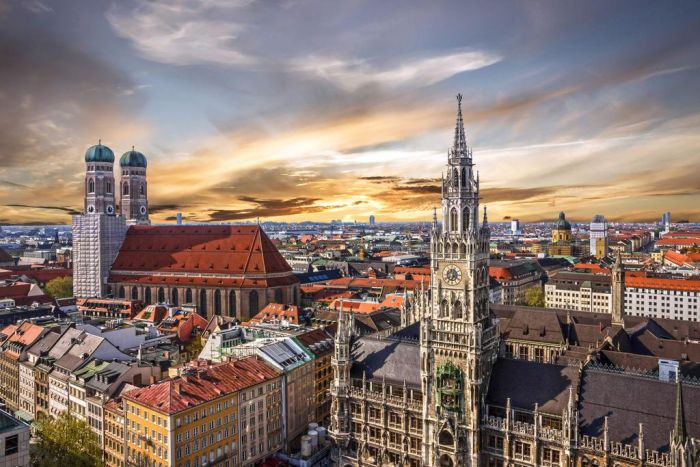
German universities are distinguished by high quality of education, variety of programs.
In the top of world rankings regularly appear:
- Free University of Berlin;
- Brandenburg University of Technology;
- University of Heidelberg;
- University of Mannheim;
- Albert Ludwig University.
Each university has its own requirements for students, approach to education and choice of programs. To study, you need to master a special program and pass an exam on German language proficiency at level B2. Each semester requires contributions of a small amount.
Austria

As in Germany, at Austrian universities you need to pay semester fees when getting education for free. Their amount is higher than in Germany, but there are universities requiring only a small amount. You can enter Austrian educational institutions immediately after 11th grade, you don't need to take preparatory programs.
Free education is possible in the educational institutions of Poland, Finland, Spain and other EU states. They offer various educational programs, and it is not difficult to choose the right one. Among the main conditions for admission to them is knowledge of the national language at the appropriate level.



Comments